
Ground Penetrating Radar (GPR)
See What’s Below The Surface, Without Disturbing It
Ground Penetrating Radar (GPR) is a non-invasive technology that uses electromagnetic waves to detect and map features beneath the ground. Identifying subsurface conditions quickly and safely, helping project teams make informed decisions before excavation, drilling, or construction begins.
GPR Works By Transmitting High-Frequency Electromagnetic Waves Into The Ground
When those waves encounter changes or boundaries in material, such as soil, rock, concrete, metal, or voids, some of the signal is reflected back to the surface. Our equipment records the strength of the signals received and displays them as radargrams. These radargrams can be used in context to interpret underground features without digging, drilling, or disrupting the site.
GPR Works By Transmitting High-Frequency Electromagnetic Waves Into The Ground
When those waves encounter changes or boundaries in material, such as soil, rock, concrete, metal, or voids, some of the signal is reflected back to the surface. Our equipment records the strength of the signals received and displays them as radargrams. These radargrams can be used in context to interpret underground features without digging, drilling, or disrupting the site.
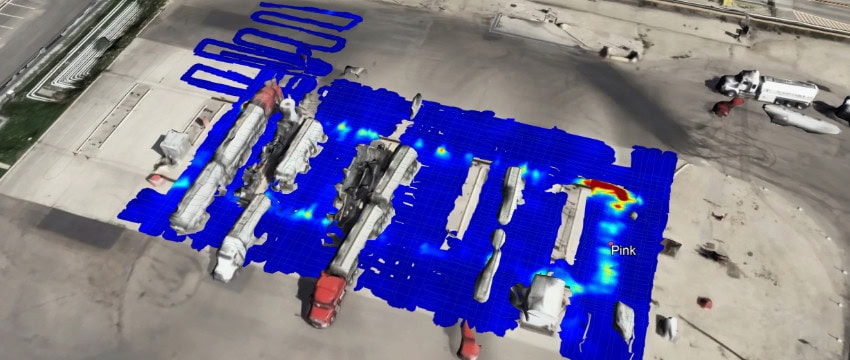
How Ground Penetrating Radar Works
Our GPR systems use a range of antenna frequencies, between 100MHz – 1500MHz depending on the job. Lower frequencies penetrate deeper into the ground but show lower resolution, while higher frequencies capture finer resolution at a shallower depth. The frequency used is selected based on your project needs, whether it involves geophysical and geotechnical surveys, identifying deep utilities, scanning within concrete, asphalt, or bridge decks, or looking for utility locates, underground storage tanks, drainage systems, archaeology or forensics.
As the equipment is moved across the surface, it continuously transmits electromagnetic waves and records the reflected signals. This data is then processed and interpreted by our experienced team so the results can be used in context and integrated with survey controls and other spatial data to provide a clear picture of what is located underground.
What Can GPR Detect?
GPR is a versatile tool that can be used to identify a wide range of subsurface features, including:
What Can GPR Detect?
GPR is a versatile tool that can be used to identify a wide range of subsurface features, including:
• Underground utilities and services
• Voids, air pockets, and buried debris
• Changes in soil or material composition
• Rebar, post-tension cables, and conduits in concrete
• Groundwater table indicators
• Ice depth and frozen ground conditions
• Previously excavated or backfilled areas
• Bedrock depth and shallow rock obstructions

Considerations
Like all technologies, Ground Penetrating Radar performance depends on site conditions. Results can be influenced by soil composition, moisture content, depth, and the size and material of the target. Local ground and soil conditions can greatly affect depth of penetration and may limit its effectiveness in certain areas for an application. Clay, saturated sand, silt and concrete result in shallower ranges while sand, gravel, rock and ice penetrate to deeper depths.
GPR can be used to locate non-metallic pipes and is an essential tool for utility locating. Whereas electromagnetic locating technology cannot identify non-metallic pipes unless they were installed with tracer wire, GPR is capable of detecting both metal objects, such as pipes, and non-metallic objects. However, a metal plate at the surface can block signals from reaching deeper layers. Our team evaluates site conditions and project objectives to ensure GPR is the right fit for your project, if it isn’t, we will recommend complementary methods if needed.
Advantages of GPR
Advantages of GPR
• Non-invasive and non-destructive
• Reduces the risk of utility strikes and costly delays
• Safe for use in public spaces and active project sites
• Detects both metallic and non-metallic objects and pipes
• Provides immediate, real-time results in the field
• Minimizes ground disturbance and associated costs
• Can be georeferenced for improved positional accuracy
• Often more cost-effective than traditional exploratory methods

When to Use GPR
Ground Penetrating Radar is ideal for projects that require insight below the surface without disruption, including:
- Utility locating and verification
- Concrete scanning before cutting or coring
- Infrastructure and facility assessments
- Environmental and geotechnical investigations
- Construction planning and risk mitigation
When to Use GPR
Ground Penetrating Radar is ideal for projects that require insight below the surface without disruption, including:
When to Use GPR
Ground Penetrating Radar is ideal for projects that require insight below the surface without disruption, including:
• Utility locating and verification
• Concrete scanning before cutting or coring
• Infrastructure and facility assessments
• Environmental and geotechnical investigations
• Construction planning and risk mitigation